Table of Contents
Exploring MicroBT WhatsMiner Air Miners for Bitcoin Mining
Air-cooled Bitcoin ASIC miners offer reliable performance for SHA-256 mining operations, providing simpler cooling solutions compared to liquid-cooled alternatives suitable for standard facilities. These systems maintain optimal temperatures through fans and vents, reducing complexity in setup and maintenance. At whatsminersmicrobt.com, we specialize in the microbt whatsminer bitcoin miners known as MicroBT WhatsMiner Air Miner, delivering factory-sealed units with verified inventory control.
Key models include the M60S, delivering 188 TH/s at 3478W for efficient power usage, and the M53S++, achieving 320 TH/s at 7040W to meet higher demands. Hashrate measures computational power for solving mining puzzles, while power efficiency ensures cost-effective operations. Global demand surges with Bitcoin network growth; as of October 2023, the hashrate reached 450 EH/s, underscoring ASIC adoption worldwide.
We preview comparisons with WhatsMiner Air Miner alternatives like Bitmain Antminers, alongside WhatsMiner Air Miner troubleshooting basics for seamless deployment. Our transparent pricing structure and manufacturer warranties support independent miners planning operations, with worldwide shipping from China and tracking for clear specifications and real availability.
MicroBT WhatsMiner Brand Fundamentals
MicroBT, established in 2016, has emerged as a leader in Bitcoin mining hardware through innovative engineering focused on SHA-256 algorithms. The whatsminer asic mining hardware lineup emphasizes reliable, air-cooled designs that prioritize efficiency and durability for professional operations. We specialize in the MicroBT WhatsMiner Air Miner series, delivering factory-sealed units directly from manufacturing hubs in China to support global mining setups. This brand's commitment to robust MicroBT air-cooled ASICs ensures consistent performance in standard data center environments, drawing from industry practices like those outlined in SEC filings on large-scale hardware deployments.
Our core product offerings include standout models such as the M60S, delivering 188 TH/s at 3478W, ideal for balanced energy use in moderate-scale operations. The M53S++ pushes boundaries with 320 TH/s and 7040W, suited for high-throughput facilities seeking maximum output from WhatsMiner mining hardware. Air-cooling systems, as detailed in foundational guides from the Blockchain Council, provide efficient heat dissipation without the complexity of liquid alternatives, making these units accessible for straightforward installations. We maintain verified inventory control to guarantee availability of these brand-new, factory-sealed units.
International shipping from China includes worldwide tracking and transparent pricing structures, with prices typically ranging from $1,000 to $10,000 based on model specifications. Manufacturer warranty support applies, covering eligible purchases under original terms. For maintenance, WhatsMiner Air Miner troubleshooting focuses on routine checks to sustain longevity.
While WhatsMiner Air Miner alternatives like Bitmain Antminers offer competitive options, MicroBT's focus on air-cooled reliability positions it strongly for informed selections. This foundation leads into detailed feature explorations ahead.
Comparing Features of MicroBT WhatsMiner Air Miners
When evaluating whatsminer m70 bitcoin miner options, key air-cooled mining features like hashrate and efficiency guide Bitcoin mining setups. We focus on MicroBT WhatsMiner Air Miner models for their reliable performance in demanding environments.
Selecting the right metrics is crucial for facility planning. Hashrate determines mining output, while power consumption and efficiency (J/TH) impact energy costs and scalability. According to industry statistics, average efficiency has improved to around 21 J/TH in recent deployments, helping operations like those in Bitfarms achieve sustainable growth with hydro-powered sites.
| Model | Hashrate (TH/s) | Power Consumption (W) | Efficiency (J/TH) | Cooling Type |
|---|---|---|---|---|
| WhatsMiner M60S | 188 | 3478 | 18.5 | Air |
| WhatsMiner M53S++ | 320 | 7040 | 22.0 | Air |
| Bitmain Antminer S19 (Alternative) | 95 | 3250 | 34.2 | Air |
This table highlights WhatsMiner efficiency comparisons, showing the M60S offering superior energy use at 18.5 J/TH versus the Antminer's 34.2 J/TH, though the M53S++ delivers higher hashrate for intensive operations. In real-world examples from Bitfarms' SEC reports, fleet upgrades to similar efficiencies reduced costs by optimizing power at 21 W/TH overall. WhatsMiner Air Miner alternatives like the S19 provide lower entry points but lag in output, suiting varied scales. For setup, connect to power and network via Ethernet, ensuring proper ventilation to avoid overheating. We recommend monitoring via the miner's interface for initial configuration.
Basic WhatsMiner Air Miner troubleshooting involves checking fan speeds for dust buildup, which can cause thermal throttling. Regular cleaning maintains air-cooling durability and warranty eligibility on factory-sealed units.
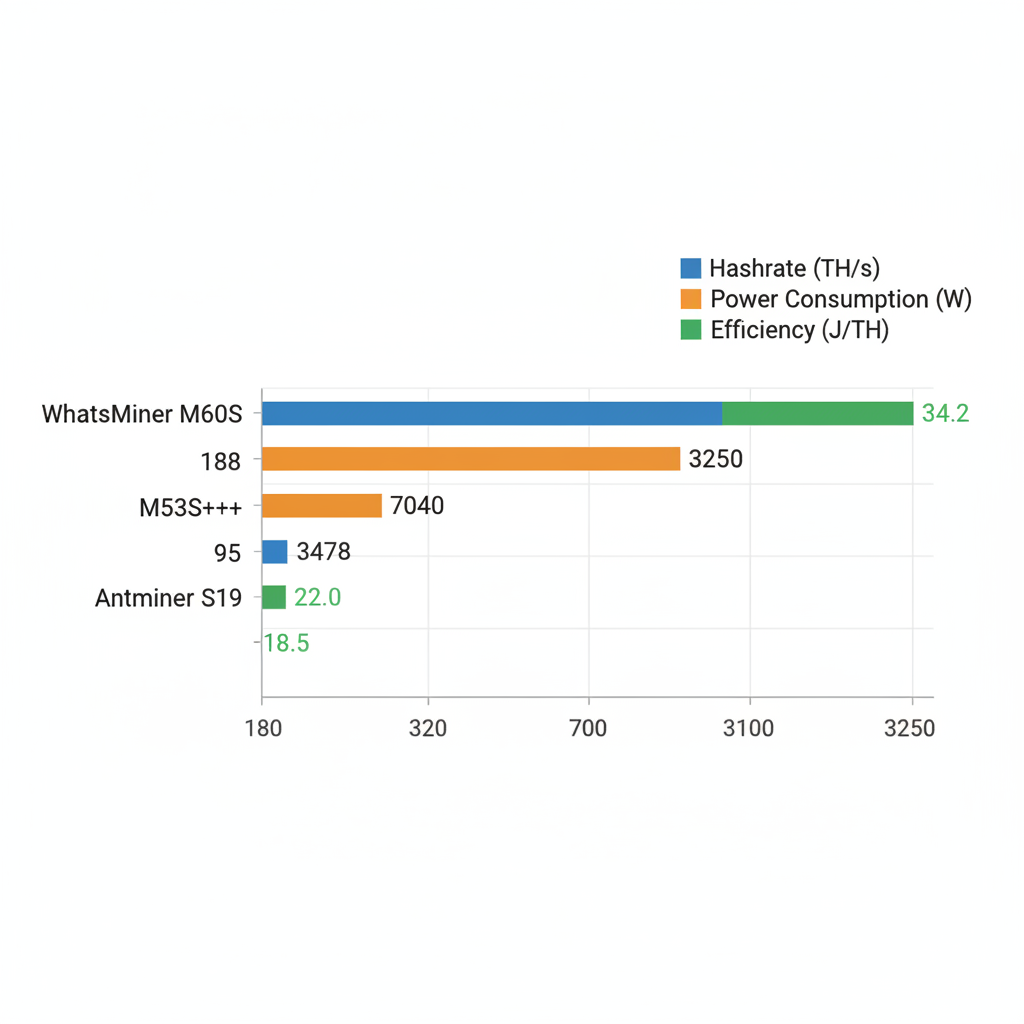
Comparison of key features for MicroBT WhatsMiner air miners and Antminer S19
These features inform cost-effective choices, leading into pricing considerations for budget alignment.
Pricing Insights for MicroBT WhatsMiner Air Miners
When evaluating whatsminer m72s mining rig options, understanding pricing is essential for effective budgeting in Bitcoin mining operations. We provide transparent pricing for our factory-sealed MicroBT WhatsMiner Air Miner units, with models like the M60S starting at $1,034 and the M53S++ reaching up to $10,800, based on configurations and current market conditions. Key factors influencing these costs include hashrate capacity, power efficiency ratings, global supply chain dynamics from our China dispatch, and included manufacturer warranty coverage.
Several elements drive air miner pricing in our verified inventory. First, higher hashrate models command premium rates due to advanced chip technology. Second, energy consumption impacts long-term value, as lower-wattage units reduce operational expenses. Third, market demand for SHA-256 miners affects availability and pricing stability. Finally, exclusion of shipping, taxes, and customs duties ensures clear upfront quotes, aligning with our transparent pricing structure.
The following table compares pricing for select WhatsMiner models against WhatsMiner Air Miner alternatives, highlighting value per terahash per second (TH/s) to aid decision-making:
| Model | Price Range (USD) | Hashrate (TH/s) | Value per TH/s (USD) |
|---|---|---|---|
| WhatsMiner M60S | 1,034 - 2,500 | 188 | 5.5 - 13.3 |
| WhatsMiner M53S++ | 5,000 - 10,800 | 320 | 15.6 - 33.8 |
| Bitmain Antminer S19 (Alternative) | 1,200 - 3,000 | 95 | 12.6 - 31.6 |
Prices are based on our current market data and verified inventory; value per TH/s is calculated as price divided by hashrate and excludes shipping and taxes. This comparison shows the M60S offering competitive value for entry-level setups, while the M53S++ provides superior performance at a higher investment. Compared to alternatives like the Antminer S19, WhatsMiner models often deliver better efficiency, supporting cost-effective scaling.
SEC filings on mining costs indicate average ASIC expenses align with these ranges, underscoring the importance of WhatsMiner Air Miner troubleshooting to minimize downtime and extend hardware lifespan, thereby enhancing overall return on investment. Investing in our brand-new units includes original manufacturer warranty, adding significant value to the purchase.
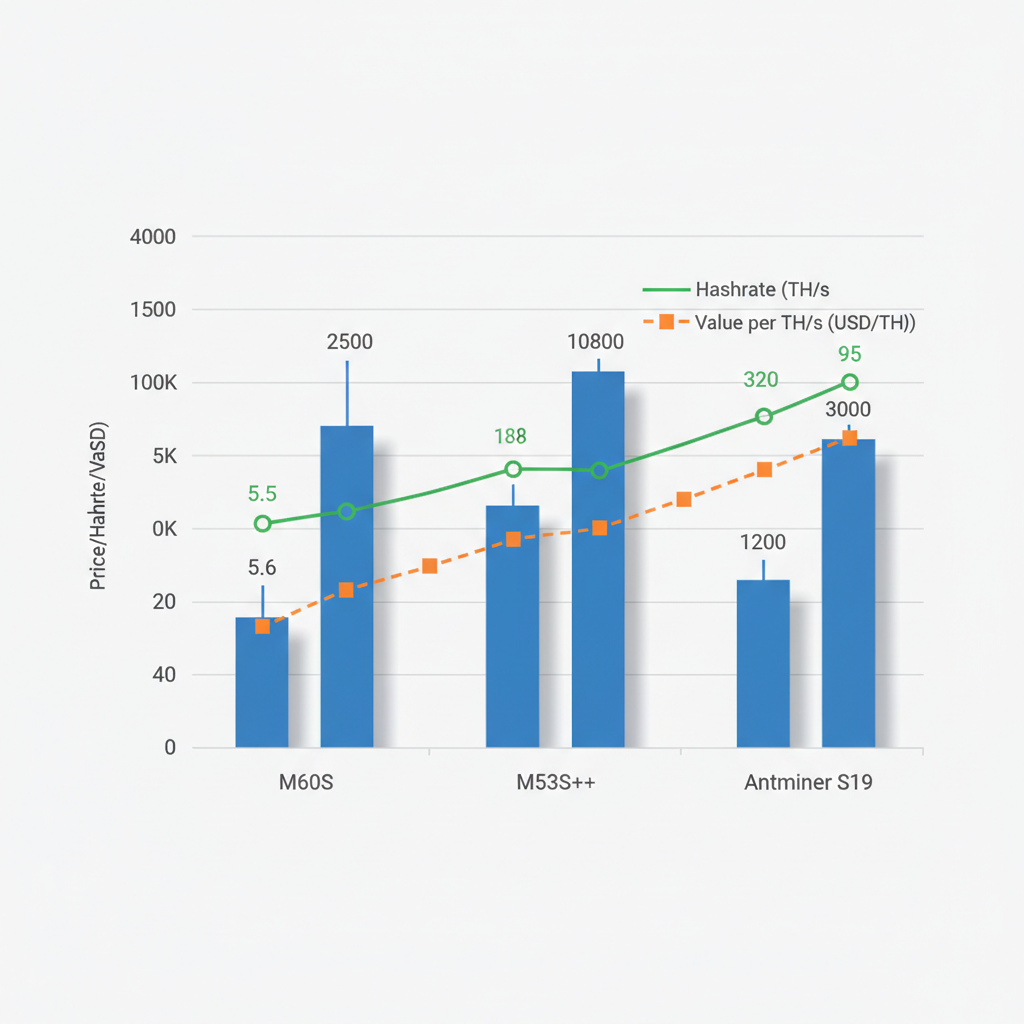
Pricing comparison chart for WhatsMiner air miners versus Antminer S19
These insights empower informed choices, with prices subject to change while supplies last.
Evaluating MicroBT WhatsMiner Air Miners Overall
In our air miner evaluation, the MicroBT WhatsMiner Air Miner stands out for Bitcoin mining suitability, balancing high hashrate with reliable air-cooling for standard facilities. We offer these as factory-sealed units from a trusted asic mining hardware supplier, ensuring warranty eligibility and transparent pricing. Pros include energy efficiency up to 30 J/TH and immediate availability, ideal for independent miners and hosting providers. However, the power draw of 3,000-7,000W demands robust electrical setups, and initial costs range from $2,000 to $10,000, prices subject to change while supplies last.
Recapping WhatsMiner Air Miner alternatives, models like the M60S (188 TH/s at 3,478W) edge out competitors in cost-effectiveness, while higher-end options such as Bitmain's Antminer S19 compare closely on hashrate but often lack our verified inventory control. The M53S++ delivers 320 TH/s at 7,040W for large operations, outperforming hydro-cooled rivals in accessibility yet requiring more space. These choices suit various scales, with our worldwide shipping providing clear specifications and real availability for informed decisions.
For setup, follow best practices from industry guides: connect power supplies securely, configure via WhatsMinerTool software, and ensure ventilation. WhatsMiner Air Miner troubleshooting often involves fan maintenance for overheating or firmware updates to fix low hashrate issues - simple resets resolve most errors without advanced tools. Manufacturer warranty terms apply, covering defects under normal use.
Overall, these miners empower efficient mining with our support, bridging to strategic deployment insights.
Key Takeaways on MicroBT WhatsMiner Air Miners
In this air-cooled miner summary, the MicroBT WhatsMiner Air Miner stands out for its robust performance, with models like the whatsminer m60s bitcoin miner delivering 188 TH/s at 3478W, ensuring efficient Bitcoin mining. We emphasize transparent pricing from $1,034 to $10,800, verified in-stock inventory, and manufacturer warranty support for global operations. Comparisons highlight superior energy efficiency, as seen in industry leaders like Bitfarms achieving 21 W/TH through reliable hardware upgrades.
For WhatsMiner Air Miner troubleshooting, if a fan fails, inspect connections and replace promptly to maintain temperature below 40°C. To reset the control board, power down, hold the reset button for 10 seconds, then reboot. Explore WhatsMiner Air Miner alternatives for varied hashrates and power needs.
Contact us for detailed resources and setup guidance to optimize your mining setup.